IDEAS HAVE CONSEQUENCES
Richard Weaver
1948
Discussion Questions:
1. Does Weaver present a cogent argument for his position that it was Nominalism (a denial of transcendentals), as upheld by William of Occam, which changed the course of Western culture?
2. Is the term 'materialism' used correctly (i.e. the complete denial of anything other than the material world) or does it usually imply an inordinate values system?
3. Even if we agree with Weaver's analysis of what ails Western culture, do we agree with his prognosis and prescription?
4. Is the middle class really the villain of the piece?
Friday, October 26, 2007
Thursday, October 25, 2007
Road Trip

THE LOST CONTINENT Travels in Small-Town America
Bill Bryson
Perenial, 1990
Bill Bryson's travel books are best-sellers and it's easy to see why. He combines interesting facts with humorous commentary. He captures the experience of the bulk of American tourists, whether abroad or driving around the country on summer vacation. Sometimes vulgar, sometimes irreverent, his books make amusing and light summer reading.
"I come from Des Moines. Somebody had to. When you come from Des Moines you either accept the fact without question and settle down with a local girl named Bobbi and get a job at the Firestone factory and live there forever and ever, or you spend your adolescence moaning at length about what a dump it is and how you can't wait to get out, and then you settle down with a local girl named Bobbi and get a job at the Firestone factory and live there forever and ever. Hardly anyone ever leaves. This is because Des Moines is the most powerful hypnotic known to man. ... Everybody in Des Moines is strangely serene."
"I was headed for Nebraska. Now there's a sentence you don't want to have to say too often if you can possible help it. Nebraska must be the most unexciting of all the states. Compared with it, Iowa is paradise. Iowa at least is fertile and green and has a hill. Nebraska is like a 75,000-square-mile bare patch. In the middle of the state is a river called the Platte, which at some times of the year is two or three miles wide. It looks impressive until you realize that it is only about four inches deep. You could cross it in a wheelchair. On a landscape without any contours or depressions to shape it, the Platte just lies there, like a drink spilled across a tabletop. It is the most exciting thing in the state."
"I hate the way these places let you get all the way there before disclosing just how steep and confiscatory the admission price is. ... I mean honestly, $24.50 just to walk around a restored village for a couple of hours. I gave silent thanks that I had ditched the wife and kids at Manchester Airport. A day out here with the family could cost almost $100 - and that's before paying for ice creams and soft drinks and sweatshirts saying, BOY, WERE WE SCREWED AT COLONIAL WILLIAMSBURG."
"National park visitors' centers are always the same. They always have some displays in glass cases that manage to be both boring and uninformative, ... , some racks of books and brochures with titles like Pewter in History and Vegetables of Old Philadelphia, ... "
Other titles by the same author:
- A Walk in the Woods (walking the Appalachian Trail)
- Neither Here Nor There, Travels in Europe
- Notes From a Small Island (England)
- In a Sunburned Country (Australia)
Bill Bryson
Perenial, 1990
Bill Bryson's travel books are best-sellers and it's easy to see why. He combines interesting facts with humorous commentary. He captures the experience of the bulk of American tourists, whether abroad or driving around the country on summer vacation. Sometimes vulgar, sometimes irreverent, his books make amusing and light summer reading.
"I come from Des Moines. Somebody had to. When you come from Des Moines you either accept the fact without question and settle down with a local girl named Bobbi and get a job at the Firestone factory and live there forever and ever, or you spend your adolescence moaning at length about what a dump it is and how you can't wait to get out, and then you settle down with a local girl named Bobbi and get a job at the Firestone factory and live there forever and ever. Hardly anyone ever leaves. This is because Des Moines is the most powerful hypnotic known to man. ... Everybody in Des Moines is strangely serene."
"I was headed for Nebraska. Now there's a sentence you don't want to have to say too often if you can possible help it. Nebraska must be the most unexciting of all the states. Compared with it, Iowa is paradise. Iowa at least is fertile and green and has a hill. Nebraska is like a 75,000-square-mile bare patch. In the middle of the state is a river called the Platte, which at some times of the year is two or three miles wide. It looks impressive until you realize that it is only about four inches deep. You could cross it in a wheelchair. On a landscape without any contours or depressions to shape it, the Platte just lies there, like a drink spilled across a tabletop. It is the most exciting thing in the state."
"I hate the way these places let you get all the way there before disclosing just how steep and confiscatory the admission price is. ... I mean honestly, $24.50 just to walk around a restored village for a couple of hours. I gave silent thanks that I had ditched the wife and kids at Manchester Airport. A day out here with the family could cost almost $100 - and that's before paying for ice creams and soft drinks and sweatshirts saying, BOY, WERE WE SCREWED AT COLONIAL WILLIAMSBURG."
"National park visitors' centers are always the same. They always have some displays in glass cases that manage to be both boring and uninformative, ... , some racks of books and brochures with titles like Pewter in History and Vegetables of Old Philadelphia, ... "
Other titles by the same author:
- A Walk in the Woods (walking the Appalachian Trail)
- Neither Here Nor There, Travels in Europe
- Notes From a Small Island (England)
- In a Sunburned Country (Australia)


More Blood and Guts
ALL QUIET ON THE WESTERN FRONT
Erich Maria Remarque
Discussions Questions:
1. Did the capacity for fighting and war exist in man before the Fall or is it a result of original sin? Was Adam a warrior before the Fall? Should he have physically protected Eve from the Serpent? (Remember the great scene in 'Perelandra' when Ransom engages in physical combat with the 'devil') Aquinas says that carnivores were created with sharp teeth and mosquitoes with stingers, which were used ordinately before the Fall (i.e. in the correct manner, on the correct victim, at the correct time, etc.). Does this same theory apply to man and his fighting instincts?
2. Are fighting and warfare always the result of vice (envy, anger, pride, etc)? Are they a mark of civilization or barbarism?
3. Fighting obviously corresponds to something deep within the male. Are there born warriors, men who by nature are designed for this purpose? Is every man capable of being a warrior? If not, is that a deficiency?
4. How should we handle this 'fighting instinct' with our boys?
5. How does the natural instinct to protect become inordinate? What are the effects of this inordinate passion? (think back to 'The Great Santini')
6. What psychological effects does war have on the loser? The victor?
7. Should war be avoided at all costs? Has modern warfare gone "too far"? Can war be regulated? What happens, for instance, when one party refuses to play by the rules? Looking at history we see that it is often the party who is willing to break the rules who ends up victorious. Is this honorable or dishonorable; is it a question of the end justifying the means?
8. Is demanding 'unconditional surrender' a wise policy? To what extent should we seek to completely annihilate our enemies? Is there a difference between spiritual and material warfare in this regard?
Further Reading:
- 'The Great Santini' by Pat Conroy
Erich Maria Remarque
Discussions Questions:
1. Did the capacity for fighting and war exist in man before the Fall or is it a result of original sin? Was Adam a warrior before the Fall? Should he have physically protected Eve from the Serpent? (Remember the great scene in 'Perelandra' when Ransom engages in physical combat with the 'devil') Aquinas says that carnivores were created with sharp teeth and mosquitoes with stingers, which were used ordinately before the Fall (i.e. in the correct manner, on the correct victim, at the correct time, etc.). Does this same theory apply to man and his fighting instincts?
2. Are fighting and warfare always the result of vice (envy, anger, pride, etc)? Are they a mark of civilization or barbarism?
3. Fighting obviously corresponds to something deep within the male. Are there born warriors, men who by nature are designed for this purpose? Is every man capable of being a warrior? If not, is that a deficiency?
4. How should we handle this 'fighting instinct' with our boys?
5. How does the natural instinct to protect become inordinate? What are the effects of this inordinate passion? (think back to 'The Great Santini')
6. What psychological effects does war have on the loser? The victor?
7. Should war be avoided at all costs? Has modern warfare gone "too far"? Can war be regulated? What happens, for instance, when one party refuses to play by the rules? Looking at history we see that it is often the party who is willing to break the rules who ends up victorious. Is this honorable or dishonorable; is it a question of the end justifying the means?
8. Is demanding 'unconditional surrender' a wise policy? To what extent should we seek to completely annihilate our enemies? Is there a difference between spiritual and material warfare in this regard?
Further Reading:
- 'The Great Santini' by Pat Conroy
Wednesday, October 24, 2007
2008 Reading List
- A History of the World in 6 Glasses - Tom Standage
- Wives and Daughters - Elizabeth Gaskell
- Home - Witold Rybczynski
- Brideshead Revisited - Evelyn Waugh
- The Defamation of Pius XII - Ralph McInerney
- Picture of Dorian Grey - Oscar Wilde
- The Canterbury Tales - Geoffrey Chaucer
- Death Comes For the Archbishop - Willa Cather
- The Heresy of Formlessness - Martin Mosebach
- The Cocktail Party - T.S.Eliot
- What's Wrong with the World - G.K.Chesterton
Sunday, October 21, 2007
It Was a Dark and Stormy Night
ETHAN FROME
Edith Wharton
Discussion Questions:
1. Literary critic Lionel Trilling wrote in his essay, 'The Inertia of Morality', "I had not read Edith Wharton's little novel in a good many years ... I recalled it as not at all the sort of book that deserved to stand in a list which included The Brothers Karamazov and Billy Budd ... when I read it again it turned out to be pretty much as I had recalled it, not a great book or even a fine book, but a factitious book, perhaps even a cruel book."
Did you have a similar reaction? Why or why not?
2. What are the temperaments of the three main characters: Ethan, Mattie and Zeena? Does the author cause you to like or care about any of them? Is Ethan strong or weak, courageous or cowardly? Is he a tragic hero, one whose basic goodness and superiority are marred by a tragic flaw such as pride, ambition, or poor judgment, leading to his downfall?
3. Could Ethan ever have found a way to be happy in his marriage to Zeena, assuming he hadn't met Mattie? Should he have run away with Mattie? Are some marriages too awful? Did he and Mattie deserve their fate? Is that Wharton's point?
4. Ethan Frome was written while Edith Wharton lived in Paris away from her husband, following a passionate but doomed love affair there with a married man. Is this novel a justification for her own actions, a general social critique, or a story that just had to be told, having a life of its own? Does the novel hold together as a novel, or does it seem contrived, even a literary experiment on the part of the author? (Note the author's introduction)
5. The setting is almost a fourth character in the novel. Why does most of the action take place in winter? Any thoughts on why Wharton chose a rural New England setting depicting extreme poverty that is very different than her usual high society type of setting? Is she successful (i.e. believable) in portraying Frome's situation? How does the presence of the narrator contribute (or not) to the novel's success?
6. There is little if any mention of God or religion other than the church at the bottom of the hill, where the only activity is dancing, not worship. Does this absence strike you as odd? Why does Wharton so pointedly leave out this important cultural element of New England village life?
7. Wharton was a devotee of Naturalism, a school of thought that makes individuals victims of forces outside themselves, such as heredity, environment, and conventional culture. Explain how this is played out in Ethan Frome.
8. Some critics have likened this story to an inverted fairly tale. Do you see any resemblance to traditional fairy tales? What fairy tale elements do you see? How is this story different?
9. Trilling also wrote, "There is in Ethan Frome an image of life-in-death, of hell-on-earth, which is not easily forgotten: the crippled Ethan and Zeena, his dreadful wife, and Mattie, the once charming girl he had loved, now bedridden and querulous with pain, all living out their death in the kitchen of the desolate Frome farm - a perpetuity of suffering memorializes a moment of passion. It is terrible to comtemplate, it is unforgettable, but the mind can do nothing with it, can only endure it ... What is more, the novel seemed to me quite unavailable for any moral discourse. In the context of morality, there is nothing to say about Ethan Frome. It presents no moral issue."
Do you agree? If not, what moral issue is considered in the novel? Does the situation of this novel make sense in today's world? Could it happen now? Would a typical young American today even understand the limitations these characters faced?
10. Trilling goes on to state, however, that, "there is in Ethan Frome an idea of considerable importance, which is this: that moral inertia, the not making of moral decisions, constitutes a large part of the moral life of humanity. This isn't an idea that literature likes to deal with. Literature is charmed by energy and dislikes inertia. It characteristically represents morality as positive action ... Yet the dull daily world sees something below this delightful preoccupation of literature and moral philosophy. It is aware of the morality of inertia, and of its function as a social base, as a social cement. It knows that duties are done for no other reason than that they are said to be duties; for no other reason, sometimes, than that the doer has not really been able to conceive of any other course, has, perhaps, been afraid to think of any other course ... This is the morality of habit, or the morality of biology ... This is morality as it is conceived by the great mass of people in the world. And with this conception of morality goes the almost entire negation of any connection between morality and destiny. A superstitious belief in retribution may play its part in the thought of simple people, but essentially they think of catastrophes as fortuitous, without explanation, without reason."
Have you observed this moral inertia? Is it beneficial or detrimental? Is it possible, desirable, or even obligatory to rise above this unthinking approach to morality? What elements in a person's life could make such a higher moral view possible? Do people often live on differing levels of moral awareness depending on the moral issue at hand, thus living in a kind of dualistic way?
Thanks to Nancy for these questions!
Edith Wharton
Discussion Questions:
1. Literary critic Lionel Trilling wrote in his essay, 'The Inertia of Morality', "I had not read Edith Wharton's little novel in a good many years ... I recalled it as not at all the sort of book that deserved to stand in a list which included The Brothers Karamazov and Billy Budd ... when I read it again it turned out to be pretty much as I had recalled it, not a great book or even a fine book, but a factitious book, perhaps even a cruel book."
Did you have a similar reaction? Why or why not?
2. What are the temperaments of the three main characters: Ethan, Mattie and Zeena? Does the author cause you to like or care about any of them? Is Ethan strong or weak, courageous or cowardly? Is he a tragic hero, one whose basic goodness and superiority are marred by a tragic flaw such as pride, ambition, or poor judgment, leading to his downfall?
3. Could Ethan ever have found a way to be happy in his marriage to Zeena, assuming he hadn't met Mattie? Should he have run away with Mattie? Are some marriages too awful? Did he and Mattie deserve their fate? Is that Wharton's point?
4. Ethan Frome was written while Edith Wharton lived in Paris away from her husband, following a passionate but doomed love affair there with a married man. Is this novel a justification for her own actions, a general social critique, or a story that just had to be told, having a life of its own? Does the novel hold together as a novel, or does it seem contrived, even a literary experiment on the part of the author? (Note the author's introduction)
5. The setting is almost a fourth character in the novel. Why does most of the action take place in winter? Any thoughts on why Wharton chose a rural New England setting depicting extreme poverty that is very different than her usual high society type of setting? Is she successful (i.e. believable) in portraying Frome's situation? How does the presence of the narrator contribute (or not) to the novel's success?
6. There is little if any mention of God or religion other than the church at the bottom of the hill, where the only activity is dancing, not worship. Does this absence strike you as odd? Why does Wharton so pointedly leave out this important cultural element of New England village life?
7. Wharton was a devotee of Naturalism, a school of thought that makes individuals victims of forces outside themselves, such as heredity, environment, and conventional culture. Explain how this is played out in Ethan Frome.
8. Some critics have likened this story to an inverted fairly tale. Do you see any resemblance to traditional fairy tales? What fairy tale elements do you see? How is this story different?
9. Trilling also wrote, "There is in Ethan Frome an image of life-in-death, of hell-on-earth, which is not easily forgotten: the crippled Ethan and Zeena, his dreadful wife, and Mattie, the once charming girl he had loved, now bedridden and querulous with pain, all living out their death in the kitchen of the desolate Frome farm - a perpetuity of suffering memorializes a moment of passion. It is terrible to comtemplate, it is unforgettable, but the mind can do nothing with it, can only endure it ... What is more, the novel seemed to me quite unavailable for any moral discourse. In the context of morality, there is nothing to say about Ethan Frome. It presents no moral issue."
Do you agree? If not, what moral issue is considered in the novel? Does the situation of this novel make sense in today's world? Could it happen now? Would a typical young American today even understand the limitations these characters faced?
10. Trilling goes on to state, however, that, "there is in Ethan Frome an idea of considerable importance, which is this: that moral inertia, the not making of moral decisions, constitutes a large part of the moral life of humanity. This isn't an idea that literature likes to deal with. Literature is charmed by energy and dislikes inertia. It characteristically represents morality as positive action ... Yet the dull daily world sees something below this delightful preoccupation of literature and moral philosophy. It is aware of the morality of inertia, and of its function as a social base, as a social cement. It knows that duties are done for no other reason than that they are said to be duties; for no other reason, sometimes, than that the doer has not really been able to conceive of any other course, has, perhaps, been afraid to think of any other course ... This is the morality of habit, or the morality of biology ... This is morality as it is conceived by the great mass of people in the world. And with this conception of morality goes the almost entire negation of any connection between morality and destiny. A superstitious belief in retribution may play its part in the thought of simple people, but essentially they think of catastrophes as fortuitous, without explanation, without reason."
Have you observed this moral inertia? Is it beneficial or detrimental? Is it possible, desirable, or even obligatory to rise above this unthinking approach to morality? What elements in a person's life could make such a higher moral view possible? Do people often live on differing levels of moral awareness depending on the moral issue at hand, thus living in a kind of dualistic way?
Thanks to Nancy for these questions!
Saturday, October 20, 2007
The Generation Gap
 FATHERS AND SONS
Ivan Turgenev
The Turf Bench by Ilya Repin
Discussion Questions:
1. Turgenev's goal seems to be the juxtaposition of the 'old' and the 'new' in a changing Russia. Compare:
- the female characters: Eudoxia Kukshin, Madame Odintzov and Arina Vlassyevna (Barazov's mother).
" ... my observations lead me to suppose that free-thinking women are monstrosities." (Bazarov)
- the male characters: Pavel Petrovich and the two fathers & sons.
"We break things up because we are a force." (Arkady)
" A force! The wild Kalmuk and the Mongolian have force ... We value civilization ..." (Pavel)
2. 'The Generation Gap': is it fact or fiction?
3. Compare the economic conditions in the Old and New Russia (feudalism vs. the Emancipation of the Serfs). Was it an economic or philosophic change which eventually led to the Communist Revolution?
4. Discuss the German influence on the New Russian character (romanticism vs. practicality; morality vs. nihilism; religion vs. atheism).
"A good chemist is more useful than a score of poets" (Bazarov)
5. Turgenev wrote: "If the reader doesn't come to love Bazarov, with all his coarseness, callousness, pitiless dryness and harshness, then I have missed the mark. I imagined a gloomy, wild, large figure, half grown out of the soil, strong, spiteful, honest - doomed to perish because still in the anteroom of the future."
Does the reader come to love Bazarov? How does Bazarov change over the course of the story and to what do we attribute these changes? Does he become more human, and therefore more lovable?
6. "... the Future is, of all things, the least like eternity. It is the most completely temporal part of time - for the Past is frozen and no longer flows, and the Present is all lit up with eternal rays. Hence the encouragement we have given to all those schemes of thought such as Creative Evolution, Scientific Humanism, or Communism, which fix men's affections on the Future ... we want a man hag-ridden by the Future - haunted by visions of an imminent heaven or hell upon earth - ready to break the Enemy's commands in the present if by so doing we make him think he can attain the one or avert the other ..." (C.S.Lewis, The Screwtape Letters).
Turgenev does an admirable job of portraying this temptation in the character of Bazarov. Which scenes in the story illustrate this idea of the Present vs. the Future?
"Vassily Ivanich removed his hands from his face and embraced his wife, his constant companion, with a warmth greater than he had ever shown her in his youth; she had consoled him in his grief."
7. Is Bazarov's fate ironic? Tragic? What about the fate of Russia?
Of Related Interest:
- D.B.Wyndham-Lewis' delightful spoof of Russian Literature: 'A Bouquet for Moscow'.
- P.G.Wodehouse's spoof of Russian authors and suburban literary societies: 'The Clicking of Cuthbert'.
1. Turgenev's goal seems to be the juxtaposition of the 'old' and the 'new' in a changing Russia. Compare:
- the female characters: Eudoxia Kukshin, Madame Odintzov and Arina Vlassyevna (Barazov's mother).
" ... my observations lead me to suppose that free-thinking women are monstrosities." (Bazarov)
- the male characters: Pavel Petrovich and the two fathers & sons.
"We break things up because we are a force." (Arkady)
" A force! The wild Kalmuk and the Mongolian have force ... We value civilization ..." (Pavel)
2. 'The Generation Gap': is it fact or fiction?
3. Compare the economic conditions in the Old and New Russia (feudalism vs. the Emancipation of the Serfs). Was it an economic or philosophic change which eventually led to the Communist Revolution?
4. Discuss the German influence on the New Russian character (romanticism vs. practicality; morality vs. nihilism; religion vs. atheism).
"A good chemist is more useful than a score of poets" (Bazarov)
5. Turgenev wrote: "If the reader doesn't come to love Bazarov, with all his coarseness, callousness, pitiless dryness and harshness, then I have missed the mark. I imagined a gloomy, wild, large figure, half grown out of the soil, strong, spiteful, honest - doomed to perish because still in the anteroom of the future."
Does the reader come to love Bazarov? How does Bazarov change over the course of the story and to what do we attribute these changes? Does he become more human, and therefore more lovable?
6. "... the Future is, of all things, the least like eternity. It is the most completely temporal part of time - for the Past is frozen and no longer flows, and the Present is all lit up with eternal rays. Hence the encouragement we have given to all those schemes of thought such as Creative Evolution, Scientific Humanism, or Communism, which fix men's affections on the Future ... we want a man hag-ridden by the Future - haunted by visions of an imminent heaven or hell upon earth - ready to break the Enemy's commands in the present if by so doing we make him think he can attain the one or avert the other ..." (C.S.Lewis, The Screwtape Letters).
Turgenev does an admirable job of portraying this temptation in the character of Bazarov. Which scenes in the story illustrate this idea of the Present vs. the Future?
"Vassily Ivanich removed his hands from his face and embraced his wife, his constant companion, with a warmth greater than he had ever shown her in his youth; she had consoled him in his grief."
7. Is Bazarov's fate ironic? Tragic? What about the fate of Russia?
Of Related Interest:
- D.B.Wyndham-Lewis' delightful spoof of Russian Literature: 'A Bouquet for Moscow'.
- P.G.Wodehouse's spoof of Russian authors and suburban literary societies: 'The Clicking of Cuthbert'.
Thursday, March 22, 2007
Blood and Guts

THE SONG OF ROLAND
Translated by Dorothy Sayers
Discussion Questions:
1. What is the moral of the story?
2. Of what does the tragedy consist? Which is the sin which brings it about? With the loss of a sense of sin, has modern man lost a sense of tragedy? How has tragedy been redefined?
3. What do we make of Charlemagne's fainting and weeping at the death of Roland? Lamentation has a venerable history but what is accomplished by it? Has modern man lost or gained by his inability or unwillingness to lament tragedy?
4. Does Roland have the qualities of a romantic hero? Does Roland's pride disqualify him as a hero? How do the qualities of Roland compare to those of modern romantic heroes?
5. Is the theme of Roland - the clash of civilizations - great enough to qualify the poem as secondary epic**? Does its primitive style disqualify it?
6. Does the naive and uncomplicated Christianity of the poem appeal to us and/or modern men in general?
** See 'A Preface to Paradise Lost' by C.S.Lewis for an explanation of this term
Friday, December 22, 2006
The Pickwick Papers
General Questions (Vicki):
1. This is Dickens' first novel: is it representative of his opus? Was anyone pleasantly, or unpleasantly, surprised by it?
2. Travel & adventure in comic literature is a time-honored theme dating back to the first appearance of 'Don Quixote' (2001 Reading List) in 1605. What makes 'TPP' peculiarly English?
3. 'TPP' was written as a monthly magazine serial. What is our modern equivalent? How does the average serial reader of today compare with the average Victorian reader? Are his appetites similar? Which other characters in serial literature are memorable?
4. Does satire - in the form of caracature - require charity towards one's victims? What happens when characters lose their power to charm and entertain? Can one learn about oneself, or human nature in general, from caracatures? What about irony?
5. G.K.Chesterton said of 'TPP', "it exudes that sense of everlasting youth - a sense of the gods gone wandering round England." Comment.
6. If these are "gods" - and I take that to mean that they are not human - can/should we defile them by human character analysis? Can/should one analyze Bertie Wooster?
5. In his next novel, 'Oliver Twist', Dickens employs sentimentality, idealized and grotesque characters, unrealistic events, and serious social commentary, all of which became elements of his trademark. How does Dickens' style compare with that of Jane Austen (pre-dates) and Anthony Trollope (contemporary)? Should he be considered a romantic, or a realist?
6. Is this a philosophical novel? A psychological novel? Is the switch from comedy to gravity (the prison episodes) successful?
1. This is Dickens' first novel: is it representative of his opus? Was anyone pleasantly, or unpleasantly, surprised by it?
2. Travel & adventure in comic literature is a time-honored theme dating back to the first appearance of 'Don Quixote' (2001 Reading List) in 1605. What makes 'TPP' peculiarly English?
3. 'TPP' was written as a monthly magazine serial. What is our modern equivalent? How does the average serial reader of today compare with the average Victorian reader? Are his appetites similar? Which other characters in serial literature are memorable?
4. Does satire - in the form of caracature - require charity towards one's victims? What happens when characters lose their power to charm and entertain? Can one learn about oneself, or human nature in general, from caracatures? What about irony?
5. G.K.Chesterton said of 'TPP', "it exudes that sense of everlasting youth - a sense of the gods gone wandering round England." Comment.
6. If these are "gods" - and I take that to mean that they are not human - can/should we defile them by human character analysis? Can/should one analyze Bertie Wooster?
5. In his next novel, 'Oliver Twist', Dickens employs sentimentality, idealized and grotesque characters, unrealistic events, and serious social commentary, all of which became elements of his trademark. How does Dickens' style compare with that of Jane Austen (pre-dates) and Anthony Trollope (contemporary)? Should he be considered a romantic, or a realist?
6. Is this a philosophical novel? A psychological novel? Is the switch from comedy to gravity (the prison episodes) successful?
Monday, November 06, 2006
Let Dons Delight
In his Life of the Right Reverend Ronald Knox Evelyn Waugh gives this charming example of a well-ordered relationship between an artist and his muse. Upon publication of Let Dons Delight, Ronald Knox wrote to Daphne Lady Acton:
Of course Let Dons Delight is due entirely to your influence. You
(i) forbade me to write a detective story, (ii) gave me the idea of the book, (iii) gingered me up to read all those books about it, (iv) let me bore you about it all the time it was being written, (v) marooned me at various times so that I had to write it, (vi) told me it was worth going on with, (vii) made me in a hurry to get it finished, so that I could dedicate it to you. In fact you are the formal, efficient, material and final cause of it. The Vulgate would never have been written but for St Paula saying 'Come on, now'.
Friday, November 03, 2006
2007 Reading List
- Letters From a Stoic - Seneca
- Song of Roland - translation & intro by Dorothy Sayers
- The Stranger (L'Etranger) - Albert Camus
- Selected Poems - Rudyard Kipling
- All Quiet on the Western Front - Erich Maria Remarque
- Ideas Have Consequences - Richard Weaver
- The Lost Continent - Bill Bryson
- Ethan Frome - Edith Wharton
- Fathers and Sons - Ivan Turgenev
- Not Without Parables - Catherine de Hueck Doherty
- Captive Flames - Ronald Knox
Wedding Bells
"Once you are married there is nothing left for you, not even suicide, but to be good." - Robert Louis Stevenson
 "You vixen!"
Lance Merriweather's words seemed to stop her heart beating. Was this brutal cad the man she had married? Did she love him? Had she ever loved him? Why had she married him? What was she to do? Why had she not foreseen this? Was there a remedy? Could she endure any more? What did it mean? Who was he? How had it happened? Could this be he? When did it begin? What was it he had said? Why had she answered? What was the use of going on? Was there nothing left? Had there ever been anything? What was it all about? What did he mean? How could she know? Was there anything to know? What was love? How would it all end?
- from The Misadventures of Dr.Strabismus by J.B.Morton
 "You vixen!"
Lance Merriweather's words seemed to stop her heart beating. Was this brutal cad the man she had married? Did she love him? Had she ever loved him? Why had she married him? What was she to do? Why had she not foreseen this? Was there a remedy? Could she endure any more? What did it mean? Who was he? How had it happened? Could this be he? When did it begin? What was it he had said? Why had she answered? What was the use of going on? Was there nothing left? Had there ever been anything? What was it all about? What did he mean? How could she know? Was there anything to know? What was love? How would it all end?
- from The Misadventures of Dr.Strabismus by J.B.Morton
Wednesday, November 01, 2006
2006 Luncheon
Please come prepared to vote for your favorite books in the following categories:
1. Best title
2. Best dedication
3. Best opening sentence or paragraph
4. Best introduction or prologue
5. Best closing sentence or paragraph
6. Best repartee
7. Best monologue
8. Best protagonist
9. Best antagonist
10. Best biography or autobiography
11. Best page-turner
12. Best historical novel
13. Best life of a saint
14. Best plot twist
15. Best character development
16. Best illustrations
17. Best love story
18. Best comedy
19. Best travel story
20. Best ethnic characterization
1. Best title
2. Best dedication
3. Best opening sentence or paragraph
4. Best introduction or prologue
5. Best closing sentence or paragraph
6. Best repartee
7. Best monologue
8. Best protagonist
9. Best antagonist
10. Best biography or autobiography
11. Best page-turner
12. Best historical novel
13. Best life of a saint
14. Best plot twist
15. Best character development
16. Best illustrations
17. Best love story
18. Best comedy
19. Best travel story
20. Best ethnic characterization
Wednesday, October 25, 2006
A Woman Is Only A Woman

THE WOMEN
Clare Boothe Luce, 1937, Random House
"There is a tide in the affairs of women which, taken at the flood, leads Lord knows where." - Lord Byron
"L'amour, l'amour ... where Love leads I always follow. So here I am, in Reno." - The Countess
Discussion Questions:
1. In her introduction Clare Boothe Luce implies that her play is a simple satire of a particularly "vulgar, silly and futile" set of women. Is there more to it than that?
2. Is Mary "too damned nice"?
3. "Creatures like Edith and Sylvia and Crystal can breed no 'worthy antagonists'. A 'nice' stupid woman is victimized by their nonsense; a 'nice' intelligent woman ignores them completely." - CBL.
4. What do we make of 'high society' as thus reported? Was it simply because they could afford it that upper-class women were the first to jump at divorce?
5. While CBL, and most others, concede that "not all women are like that", she does not make the same comment about men. Does the play paint a realistic portrait of men?
6. "Keeping still, when you ache to talk, is about the only sacrifice spoiled women like us ever have to make." - Mrs. Morehead. Let's talk tactics ...
7. Every character shows signs of confusion but any shred of common sense is relegated to the older generation or to the lower classes. Is this a literary device or does it reflect reality (after all, 'common sense' is supposed to be common)?
Of Interest:
- The Women, 1939, George Cukor's fabulous film starring Joan Crawford (pictured above), Norma Shearer, Rosiland Russell & many others.
- The Philadelphia Story, 1940, another Cukor film starring Katherine Hepburn, Cary Grant, Jimmy Stewart & Ruth Hussey
- High Society, 1956, a musical remake of the above starring Grace Kelly, Bing Crosby & Frank Sinatra
Thursday, October 12, 2006
Omar Revisited

The Old Omar:
Omar Khayyam
A Book of Verses underneath the Bough,
A Jug of Wine, a Loaf of Bread - and Thou
Beside me singing in the Wilderness -
Oh, Wilderness were Paradise enow!
The New Omar:
G.K.Chesterton
A book of verses underneath the bough,
Provided that the verses do not scan:
A flask of wine, a loaf of bread and thou,
Short-haired, all angles, looking like a man;
But let the wine be unfermented, pale,
Of chemicals compounded, Lord knows how,
This were indeed the Prophet's Paradise -
Ah Paradise were wilderness enow.
The Newest Omar :
Omar Khayyam
A Book of Verses underneath the Bough,
A Jug of Wine, a Loaf of Bread - and Thou
Beside me singing in the Wilderness -
Oh, Wilderness were Paradise enow!
The New Omar:
G.K.Chesterton
A book of verses underneath the bough,
Provided that the verses do not scan:
A flask of wine, a loaf of bread and thou,
Short-haired, all angles, looking like a man;
But let the wine be unfermented, pale,
Of chemicals compounded, Lord knows how,
This were indeed the Prophet's Paradise -
Ah Paradise were wilderness enow.
The Newest Omar :
Frank Sheed
A jug and a book and a dame,
And a nice shady nook for the same.
from The New Guest Room Book, Sheed & Ward, 1957
A jug and a book and a dame,
And a nice shady nook for the same.
from The New Guest Room Book, Sheed & Ward, 1957
Wodehouse on Omar:
"And I was tooling along a mossy path with the brow a bit wet with honest sweat, when there came to my ears the unmistakable sound of somebody reading poetry to someone, and the next moment I found myself confronting a mixed twosome who had dropped anchor beneath a shady tree in what is known as a leafy glade. ... I thought it odd that a chap like [Cream] should be doing such a thing. Limericks, yes. If he had been reciting limericks to her, I could have understood it. But this was stuff from one of those books they bind in limp purple leather and sell at Christmas. I wouldn't care to swear to it, but it sounded extremely like Omar Khayyam."
from How Right You Are, Jeeves, P.G.Wodehouse, Harper & Row, 1960
Thursday, September 28, 2006
Petrarch and Laura
 Francesco Petrarch is best known for The Canzoniere: 366 poems written to/for his beloved Laura. He also wrote many fine letters - such as The Ascent of Mont Ventoux - and moral essays. His Secretum is a masterful discourse between himself, St. Augustine and Lady Truth. It is a profound and rigorous examination of conscience. He is often referred to as the Father of Humanism and was an inspiration to countless poets, including Shakespeare. He was crowned with laurels in Rome for his tremendous literary achievements and is usually pictured thus.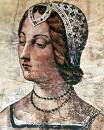
POEMS TO LAURA
Francesco Petrarch
Discussion questions:
1. The Muse: what part does she play in the artist's life and work?
2. "For the very art of being a Muse is to nourish love in the poet, to let him realize that she loves him - that in fact she loves him much too well ever to grant him anything." - Etienne Gilson, Choir of Muses. Do all Muses love this well? What happens when they don't? Is it necessary to the poet and his poetry that his Muse be unattainable?
3. "Laura is for [Petrarch] the straight road leading to the supreme Good; but though he is sure to reach this Good through her, he will never win the woman herself by whom he comes there." - Choir of Muses. Is Laura as successful as Beatrice in her mission of leading her lover to God? Do modern Muses understand the nature of their responsibility?
4. Petrarch's love is clearly, if not wholly, carnal. Are his poems more, or less, appealing than poems devoted to purely spiritual love?
5. Is Petrarch sincere? Is he in love with a real woman, or his own image of her (which does not change over the years), or in love with being in love? Which is easier? Does it matter?
6. The fruit of Petrarch's love is his poetry, but is it overly introspective?
7. His struggles against vice are a recurring theme; is a moral battleground necessary to good poetry?
Further Reading:
- Choir of Muses, Etienne Gilson, Sheed & Ward, 1953
Of Related Interest:
- Cyrano de Bergerac, play written by Edmond Rostand, 1897
- Cyrano de Bergerac, 1950, film starring Jose Ferrer, who won the Academy Award for Best Actor for this performance.
Tuesday, September 19, 2006
Dostoyevsky Is Not Considered Summer Reading
Summer Reading:
1. 84, Charing Cross Road by Helene Hanff - The charming correspondence between a New Yorker and an English book dealer.
2. The Professor & the Madman by Simon Winchester - Truth is stranger than fiction. A tale of murder, insanity & the making of the Oxford English Dictionary. Caution: there are some disturbing elements to the madness.
3. Autobiography of a Hunted Priest by John Gerard, S.J. - The story of an English Jesuit on the mission under Elizabeth I & James I. It reads like a suspense novel. Some editions have an introduction by Graham Greene.
4. Three Men in a Boat by Jerome K.Jerome - Delightful Victorian humor.
5. Wodehouse on Crime - P.G.Wodehouse - One of the better anthologies; sure to please.
6. A Year in Provence by Peter Mayle - Laugh out loud. The first in a great series.
7. A Walk in the Woods by Bill Bryson - Ditto.
8. Travels With My Aunt by Graham Greene
1. 84, Charing Cross Road by Helene Hanff - The charming correspondence between a New Yorker and an English book dealer.
2. The Professor & the Madman by Simon Winchester - Truth is stranger than fiction. A tale of murder, insanity & the making of the Oxford English Dictionary. Caution: there are some disturbing elements to the madness.
3. Autobiography of a Hunted Priest by John Gerard, S.J. - The story of an English Jesuit on the mission under Elizabeth I & James I. It reads like a suspense novel. Some editions have an introduction by Graham Greene.
4. Three Men in a Boat by Jerome K.Jerome - Delightful Victorian humor.
5. Wodehouse on Crime - P.G.Wodehouse - One of the better anthologies; sure to please.
6. A Year in Provence by Peter Mayle - Laugh out loud. The first in a great series.
7. A Walk in the Woods by Bill Bryson - Ditto.
8. Travels With My Aunt by Graham Greene
Then and Now
 "When lovely woman stoops to folly,
And finds too late that men betray,
What charm can soothe her melancholy?
What art can wash her tears away?
The only art her guilt to cover,
To hide her shame from ev'ry eye,
To give repentance to her lover,
And wring his bosom is - to die."
Oliver Goldsmith - She Stoops to Conquer
(2001 Reading List)
 "When lovely woman stoops to folly and
Paces around her room again, alone,
She smoothes her hair with automatic hand,
And puts a record on the gramaphone."
T.S.Eliot - The Waste Land
(2006 Reading List)
Saturday, September 02, 2006
Life of Johnson
 James Boswell's lengthy biography of Samuel Johnson is available in both abridged and unabridged editions. It is wise to begin with the abridged! I found an abridged version - Everybody's Boswell (G.Bell & Sons, London, 1930) - illustrated by Ernest Shepard, of all people. His illustrations are typically charming.
Boswell was the first to use actual conversation as material for biography. And Dr. Johnson had conversation in abundance: he was a philosopher, scholar, wit, curmudgeon and Establishment man.
This painting of Johnson, circa 1772, is by Sir Joshua Reynolds.
Discuss the following quotes:
(Honorary Member) Matt Anger's selections:
"Pity is not natural to man. Children are always cruel. Savages are always cruel. Pity is acquired and improved by the cultivation of reason."
"If he really does think that there is no distinction between virtue and vice, why, Sir, when he leaves our houses let us count our spoons."
"The history of manners is the most valuable. I never set a high value on any other history."
"Why, Sir, most schemes of political improvement are very laughable things."
"The excesses of hope must be expiated by pain; and expectations improperly indulged, must end in disappointment. If it be asked, what is the improper expectation which it is dangerous to indulge, experience will quickly answer, that it is such expectation raised as is dictated not by reason, but by desire; expectations raised, not by the common occurrences of life, but by the wants of the expectant; an expectation that requires the common course of things to be changed, and the general rules of action to be broken."
Anna's selections:
"Nature has given women so much power that the law has wisely given them little."
"One of the disadvantages of wine is that it makes a man mistake words for thoughts."
"Go into the street and give one man a lecture on morality and another a shilling, and see which will respect you most."
And for many more great quotes go here.
Tuesday, July 25, 2006
Transient Things

"... the tearoom will reopen where women can forget about dieting for fashion, enjoy life more, eat cakes, drink coffee or tea, sip and gossip about the transient things, which are even more important than the permanent ones ... like romance, courtship, childbirth, fidelity, infidelity and death." - John Senior, 'The Restoration of Christian Culture'
The Four Men
THE FOUR MEN
Hilaire Belloc, 1911
Hilaire Belloc, 1911
“My country, it has been proved in the life of every man that though his loves are human, and therefore changeable, yet in proportion as he attaches them to things unchangeable, so they mature and broaden.” – The Four Men
Discussion questions:
1. Were the four men portrayals of the four temperaments? The four men can also be taken as different aspects of Belloc’s personality. How much self-knowledge and integrity would it take to write such a piece about oneself? Would a ‘modern man’ be capable of it?
2. Was anyone reminded of ‘The Wind in the Willows’ while reading this story?
3. The flavor of the book is autumnal; decay and death are recurring themes. Is it right to mourn loss and alienation? Does ‘modern man’ mourn effectively? How should one mourn the loss of a civilization and all that is dear to one? What gives rise to hope in the midst of mourning?
4. There are beautiful, poetic passages describing the capacity of common things to evoke fond memories. Are ‘modern’ things capable of being this evocative? How have the senses been affected by the ‘modern’ world?
5. What is the value of companionship to ‘modern’ men? How have the customs associated with companionship changed? (drinking, singing, joking)
6. “It takes an awareness of reality to make the best jokes. An appreciation of the absurd is only possible where a man already has a grasp of things in their everyday, normal proportions.”* What has happened to humor?
7. “There are certain moods in which [Homer] seems, as it were, boys’ poetry, depending both for its charm and for its limitations on a certain naivety …” ** Is it this Homeric ring which gives the story its boyish flavor?
8. “The [Greeks] heart’s desire was the timeless, the unchangeable, and they saw time as mere flux. But the Romans were different. … Virgil’s heroes were not men fighting for their own hand like Homeric heroes; they are men with a vocation, men on whom a burden is laid.”** The Homeric ring to the story is unmistakable; is there a Virgilian ring? Does Belloc go beyond mourning a lost civilization to contemplate the transition into a new one? We cannot fault Homer for not being Virgil, nor Belloc for not being … who? Are there writers today who tackle this theme of transition? Who chronicle the “shift of civilization … the transformation of the little remnant, the reliquas, of the old, into the germ of the new.”**?
9. If we are the remnant of Western Civilization, journeying from old to new, what type of things should we be taking with us?
* All Saints and the Sussex Countryside, Matthew Anger & Michael Hennessy, The Bellocian, 2004
** A Preface to Paradise Lost, C.S.Lewis
Subscribe to:
Posts (Atom)